 Your connection to advanced PCB manufacturing

A Quantitative Path for Power
In 1841, James Prescott Joule created resistors from wires wound around glass rods. This was two decades after Georg Ohm’s experiments with lengths of wire, and before Ohm’s work was transformed into what we know today as Ohm’s law. Joule kept the diameter of the wire constant and varied the number of windings. He knew the ratio of resistances accurately, even without knowing the actual resistance of each wire. Joule submerged his wire-wound resistors in water containers and connected them in series with a tangent galvanometer and a voltaic pile (battery).
The result of Joule’s experiment is the familiar relationship between heat, resistance, and current.[1]

Where Q is the heat delivered to the water, I is the current (as measured with a galvanometer), and R is the resistance of the wire-wound resistor.
Ohm’s Law As We Know It Today
It wasn’t until 1849 that Gustav Kirchoff rewrote the findings of Ohm’s experiment by realizing that τ is current, a is ∆V, and b+x is the resistance of the system R.
Joule’s experiment is independent of Ohm’s experiment.
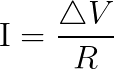
Where I is current, V is the potential difference, and R is resistance.
Kirchoff introduced the current version of Ohm’s Law, not Georg Ohm. Devices that show a direct-proportional relationship between potential difference and the product of current and resistance are termed “ohmic.”
Ohm’s law shows a direct-proportional relationship between current and potential difference – it intercepts the graph at (0,0). That means there is no minimum potential difference required to create a current in a conductor. Separate from that finding, Joule’s Law shows that all of the work done to displace charge carriers in a purely resistive circuit goes increases the internal energy of the conductor. There’s no reason that has to be the case, it’s just what nature deems so. But that finding has nothing to do with Ohm’s law. The two findings were developed independently.
Footnotes:
(1) Page 202 of Arnold Arons “Teaching Introductory Physics” Section 7.6 https://books.google.com/books?id=HpTuAAAAMAAJ
Summit Interconnect announces the addition of Mike Mathews to the position of VP/GM for the Summit Anaheim operation. Mike replaces Jack Evans who has served in the leadership position since 2018 and is directly involved in the success of the company. Jack led the operation through many improvements, and his contributions were significant and are greatly appreciated. Mike Mathews will now lead the Anaheim team in furthering Summit’s advancements in technology and manufacturing capability as we service our customers to support their expansions. Mike’s history in the industry includes manufacturing leadership positions at Sanmina, DDI and Raytheon.
About Summit
Summit Interconnect is a leading provider of complex printed circuit boards focused on fast growing defense and high-performance commercial sectors in the North American market. Summit offers solutions ranging from advanced cutting-edge prototyping to complex high mix, low-to-mid volume production. Summit’s five facilities are located across California, Illinois, and Toronto, Canada.